

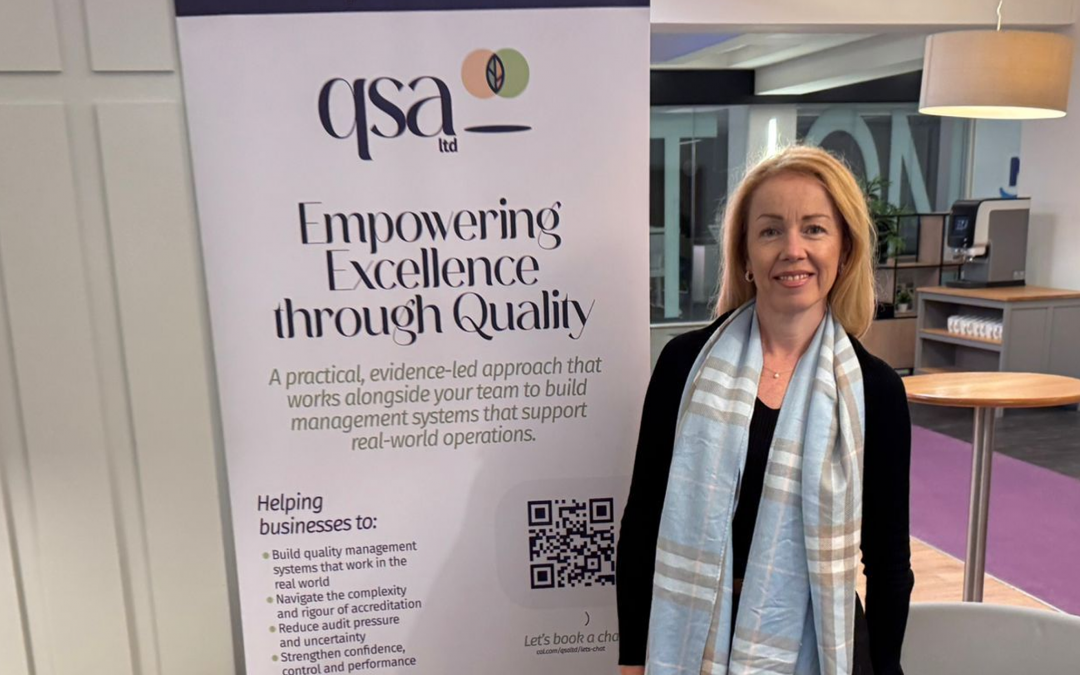
Quality systems are designed to provide clarity, control and confidence. However, when organisations work closely with their own systems every day, it can become difficult to see where small gaps or inefficiencies may exist. In this article, QSA Founder Charlotte Mahoney explores why an independent perspective is valuable in quality management and how objective reviews help organisations strengthen systems, reduce risk and approach audits with greater confidence.
Most organisations work extremely hard to maintain their quality systems. Processes are followed, documentation is maintained, and teams are focused on delivering reliable products or services – yet even well-managed systems can develop blind spots over time.
This isn’t because people are careless or unwilling to improve. It’s simply a natural effect of working closely with the same processes every day.
When teams are deeply involved in operations, it becomes harder to step back and view the system objectively.
An independent perspective helps bring that wider view.
The challenge of being too close to a system
When a quality system has been built internally and maintained over time, the people responsible for it often know it extremely well.
That familiarity is valuable. It helps teams operate efficiently and maintain continuity. However, it can also make it more difficult to recognise when parts of the system may no longer align with current operations or evolving standards.
Common examples include:
- Documentation that no longer reflects how work actually happens
- Processes that have gradually evolved without corresponding updates
- Responsibilities that have shifted informally between team members
- Evidence that exists but is difficult to locate or demonstrate clearly
These situations are rarely signs of poor management. They simply reflect the reality that businesses evolve while systems sometimes lag behind.
Why independent reviews improve quality systems
Simply put, an independent review introduces objective perspective.
Someone outside the organisation can assess how the system is working without the assumptions that naturally develop over time. This often helps identify opportunities that internal teams may not notice because they are focused on day-to-day operations.
Independent reviews typically help organisations:
- Confirm that processes reflect real operational practice
- Identify small gaps before they become larger issues
- Improve clarity around responsibilities and documentation
- Strengthen confidence ahead of external audits
- Highlight opportunities for improvement that support efficiency
In many cases, the outcome isn’t a major overhaul. More often, it’s a series of small adjustments that bring the system back into alignment with how the organisation operates today.
Evidence matters more than reassurance
One of the most valuable aspects of independent review is its focus on evidence rather than assumption.
Quality decisions should always be supported by clear, traceable information.
Independent auditors and consultants look for evidence that demonstrates how processes are operating in practice. This evidence may include:
- Records and documentation
- Process observations
- Traceability of activities
- Clear responsibility and accountability
- Consistency between documented procedures and real work
When evidence is clear, confidence follows. And without evidence, organisations often rely on reassurance or familiarity, which can create uncertainty during external audits.
Independent insight strengthens audit confidence
External audits are a normal part of operating within regulated industries and recognised standards.
In fact, independent verification plays an important role in maintaining trust across supply chains, technical services and regulated sectors.
Many organisations therefore use independent internal reviews to strengthen their systems before external assessments take place.
Research in corporate governance consistently shows that independent audit and oversight functions strengthen internal controls, improve transparency and help organisations identify risks earlier. Independent internal audit, for example, provides objective evaluation of governance, risk management and compliance processes, enabling organisations to detect operational and control weaknesses before they escalate into larger issues.
In practical terms, independent perspective helps organisations:
- Identify potential non-conformities early
- Strengthen audit preparation
- Reduce uncertainty ahead of external assessments
- Improve long-term system resilience
Rather than creating disruption, independent insight often brings reassurance and clarity.
Quality systems benefit from fresh perspective
Quality systems are designed to support consistency, reliability and confidence.
For them to remain effective, they must evolve alongside the organisations they support.
Independent perspective provides a valuable opportunity to step back, review the system objectively and ensure it continues to reflect the reality of operations.
When systems are clear, evidence is accessible and processes align with real work, quality becomes far easier to manage. It becomes something that supports performance rather than something that sits alongside it.
If you’d like an independent perspective on how your quality system is working in practice or would simply like to sense-check whether it still reflects how your organisation operates today, we’d be happy to help. Get in touch to start the conversation.